Afoot in a city as abundant in good buildings as is Barcelona, their aggregate could lessen an aficionado’s resolve to notice most any one in particular, and the stroll finds itself soon bereft of the charm which sustained it for any flâneur. But what doesn’t happen when unexpected! — turn the corner, and a marvellous edifice flashes into view, some work already known of vaguely or else just discovered, seemingly unauthored and anonymous. Catching sight of it, wonder is aroused, provoking the eyes and even ears of thought to train themselves on the corpus of architecture this one stems from and stands for. Dual synecdoches point in both directions between the sheer numbers of better examples and the special quality of the most distinguished. Each of these the reflective mind can situate next to the other, the collection of them near the most select and vice versa. Few therefore are the steps it need take, once the nexus of these givens is traced, to bestow attention on what encompasses them, how ever generally or generously defined, the setting.
Historically considered, in Barcelona the setting is replete with constructions of the later nineteenth century and early twentieth; these intertwine into urban fabrics where more recent ones, and notably the brutalist works where the materials of concrete and steel are utilised with finesse, were later super-added, something like metal rivets affixed to sheets of canvas. Of these, against such a backdrop, some are indeed striking, though this perhaps most for those who adopt a stroller’s pace, not succumbing to the haste required of the many who always are going somewhere.
Amongst several such edifices which crossed my path, on the northwestern corner at the intersection of the Via Augusta and the Carrer del Comte de Salvatierra, is a medium-sized office building which takes a cue from oxidised steel: the colour appears in opaque panes of glass set in frames which are repeated horizontally along the upper portion of its façade, in bands between which others run where the glass is transparent, which function as windows for the respective storeys; whereas the walls of the ground level, recessed on two sides from the streets, behind several pillars in a portico on one . . . — but why attempt to put into words the aspect and impression which an image of the thing does much better convey?

Between the three upper storeys, when viewed from the corner, two open levels bisect the rise of the building, configured as something like low-ceilinged loggias — so one infers from the façade of the building’s representative front half (the other does not jut out with a cantilever). What acoustic conditions these inter-storeys’ semi-enclosed spaces have to offer those who may congregate there during office hours, or at other times of day or night, whether in amplification or dampening of the sound, will remain a matter to muse over, since no concrete particulars are at hand with which to expatiate on it; nor other specifics pertaining to the architect, the brief, the date of construction, etc. Tracking down such details would require long detours, whereas now, recollecting the first sighting, it is the edifice’s whole appearance, its Gestalt, which seems the more interesting item to circle about.
At the corner, on the longer wall, fronting onto the Carrer del Comte de Salvatierra at ground level, over a surface evidently of concrete painted in a colour like that of oxidised copper, a grill of metalwork has been applied, in a pattern reminiscent of geometric forms popular in the late 1960s, while the main shape in it features once again, now blown up and cast in concrete, as elements under the windows set in a row along the upper half of the rest of the ground storey. Their utilisation is as it were meta-structural, undergirding and by an implicit sweep upwards towards the corner adding emphasis to the cantilevered upper section of the building, while at the same time (each does grin!) exceeding the role with a flourish of adornment.
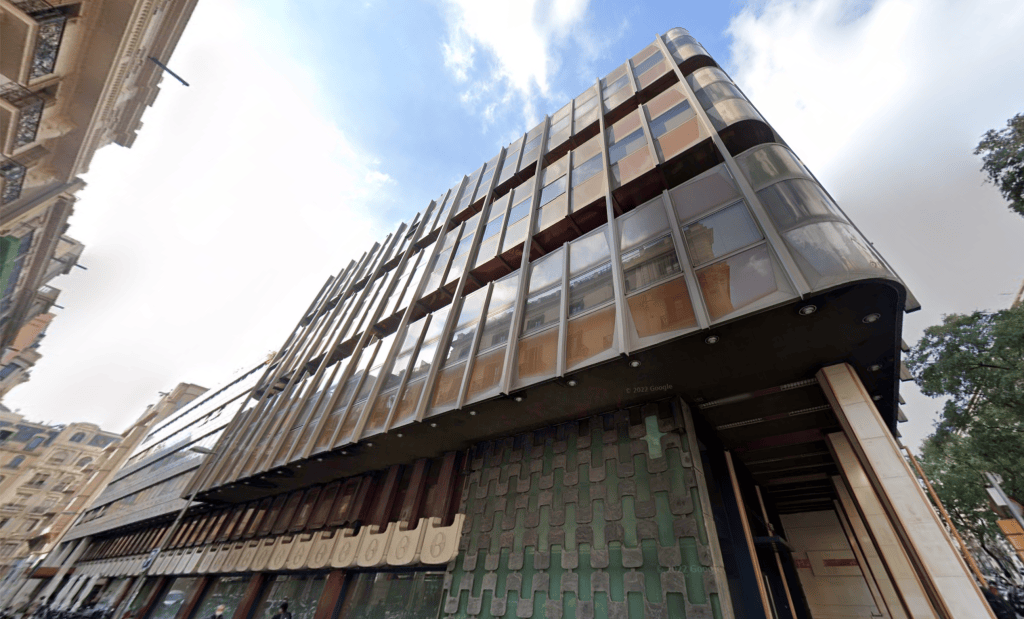
These elements together give a more precise indication of how old the building is. Brutalist influence paired with an indulgence in ornament (to call the thing by its right name): by this combination of opposites a date is inscribed under the work.
Decoration has been the bête noire of many an architect, and antagonised other professions, not least music. Unsettlingly, however, the most famous attack upon it strikes more targets the less lightly the ideas are taken: so simple it cannot be to regard ornamentation as a crime (Verbrechen).1 An offence against minds which should gather their forces, not dissipate them in tattoos, markings, appliqués, all added to the most exterior and least enduring of surfaces — vain expenditure! That was the charge levelled at ornament and its discontents, around a hundred years ago. But what hasn’t displayed a likeness to the epidermis as the decades passed by? Coverings or clothing festoon and then fall off not merely the human skin or physique; no collective entities or forms of life such as the body politic go without outermost layers, either, nor is the speed with which they are shed a constant. It, along with much else, does at times accelerate.
“Virtues” with which the otherwise undistinguished signal? Ornaments. Slogans chanted by dupes to the cause du jour? Ornaments too. Absurd words, banalities, clichéd notions, double-talk they revel in pronouncing? Ornaments as well: marks to adorn their selfhood’s thin substrates, not often inscribed without some blood. — This trend’s days may now be numbered, but even so it stems from and stands for the broad approval of ornamentation, and what disquiet does that assent provoke?
Of the ruling structures built up during roughly the last twenty years, as though in a ruse of history, by the architects of ruin at the helm in many but thankfully not all countries in the West, amongst those who did willingly offer themselves to be the ornaments, foremost have been the “woke.”* There, such “architects” on one side, amoral professionals who foment the crises they “do not let go to waste,” on the other a totalitarian system no longer quite at the outset of its development: then observers may well regard the emergent state under the aspect of a work of art, though it be one that only the generic rubric ties to the best and most classical examples of such an artifice.2 And if, with the self-duplication of organisational structures on the inside of this monstrous invention, the sheer number of its outer surfaces also increased, then almost automatically they would come to be adorned. Now, whether remedies can put the state into acceptable shape, in several locales exercises in applied political science3 are starting to ascertain. That in the process some “political scientists” do wield against the “architects” their own techniques, with different ends in view, is remarkable indeed. Notable too the response this elicits from them who have a vested interest in the status quo ante: dismay but also wonderment and even grudging admiration when they are bested, above all by their main opponent, a man who, averred one of them, creates chaos, and then curates it, as if it were precious art.4 — This remark was despite itself an homage.
* Woke — and well-paid for their many services, some who set the tone were, sub rosa to be sure, by this availability earning the title of government hookers. What songs in their honour will certain pop stars write over the years to come?
What might one infer from all this? — That not much time has to elapse and the items taken for structures will come to resemble surfaces, nor shall the further interval last very long before those surfaces themselves do start to look distinctly ornamental. — For its part, at some point the antagonism to ornament, earlier so emphatic, rigid, stern, loosens up and alights in crime, it too begins to adorn itself.
Ah, odd the outlooks and trains of thought to which stopping again, in recollection, at an item so simple as a patterned grill on a brutalist building can conduce! But perhaps just such latitude is needed if one’s mind and one’s ideas are to encounter each other afresh, each from a distance, with a degree of productive estrangement. How far may individuals and also ways of life go in living without self-ornamentation? — one query unleashed when contrary elements are sensibly juxtaposed, as was done here, heeding the famous maxim of efficiency, “Less is more.” So, whatever might be or not be the highest purpose of architecture’s labours, its aim surely is met when thoughts are electrified and set into motion, not transfixed at any spot. Edifices built with élan surpass their immobility by the ideas they help to launch.
Ornament is absent from the Biblioteca Vila de Gràcia, at the corner of the Carrer del Torrent de l’Olla and the Travessera de Gràcia, at least on the exterior as it first comes into view. — Something other than decoration, however, may strike the eyes as a stroller nears the edifice from a certain angle, especially if an idea of the overall setting speaks up.
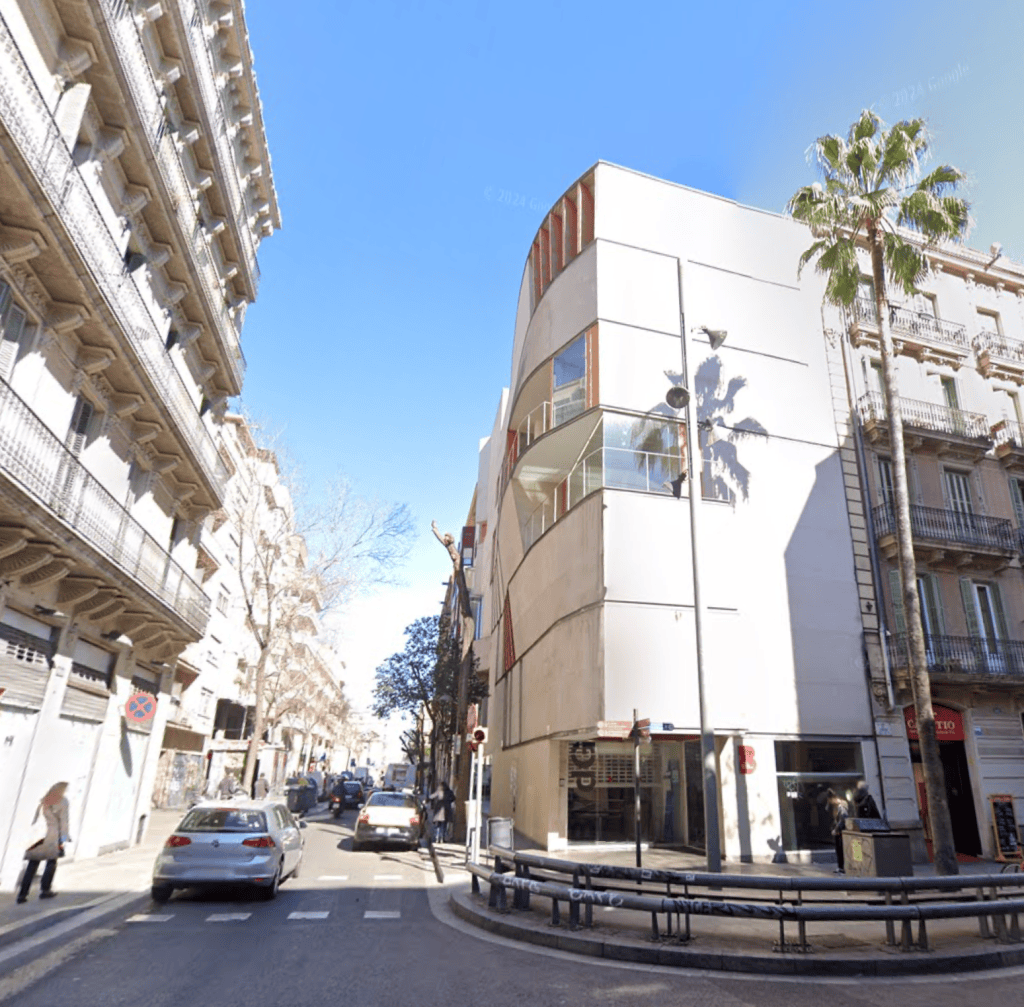
Seen from across the intersection, the building appears to comprise one side (focusing on just this facet) akin to a ship’s mast. For, the curving walls on the storeys fronting the Travessera de Gràcia do look kinetic, splayed out in shadows as if they were sails billowing in the wind, attached to the building’s corner itself, which, by the sharp contrast with the plane of the other wall, figures as a distinct element of its own, like a pole ascending upwards. So this ensemble, once noticed, brims with motion and makes an impression that then does not change nor fade!
By way of saving this phenomenon from disdain, being thrown out as a mere stray perception, as its observer I may point to the two long verticals of the lamp-post and the palm tree located right in front of the building. In effect these parallel lines do gesture towards the aspect that is their counterpart, suggesting that onlookers focus in from this precise angle on it. Curiosity then called up, old photographs were consulted: snapshots taken from this same spot matched the first impression. And one of them went even further, augmenting it entirely by chance with a small detail, of the sort that can come into view when a portion of a photograph is enlarged. Look closely just to the left of the undulating façade, not quite halfway up, and behold, a semblance appears of the figureheads once affixed to ships’ prows! Fortuitously the likeness lends force to the building’s nautical aspect! — some few seconds passed before I saw what the thing in fact was, namely, the bare upper trunk of a tree mostly swathed in the shadows and hardly to be discerned.
Even setting aside this chance occurrence, the library does utilise forms sketched out on a maritime pattern, though this becomes legible from a single perspective. Encountering the edifice from just this angle — uncovering a facet of its meaning — arouses some wonder. How ever was this imagery imbued architecturally into the building, with what degree of awareness on the part of the architect, whoever it was? Between the lines which authors set down, at times things may be said that they neither put there nor perhaps notice. Meaning it seems can slip in unawares instead. Why should the like on occasion not transpire with architects at work? “Less is more” applies to their process too.
Edifices whose overall form replicates other things’ shape, one often conceives in accord with a humorous symbolism; but symbolic influences may exert subtler and stronger effects via the forms of a building’s parts and even of its sides. Those who look at works of architecture and all they symbolise will have to prove better observers in such a case. Letting themselves be influenced by the buildings, an encounter can then take place wherein an edifice invites its public to regard it under this or that aspect. For a building to disclose any facets of itself, however, there is a general condition: the number of participants must be relatively few. Nothing could occur if masses of people do crowd out the buildings, overwhelming them quite literally in the street, and/or virtually, at the crossroads of memory and perception. Eye and ear shut to their “influence,” no meaning they harbour ever reaches any addressee. Worse yet, if the buildings themselves are “crowded out,” an insidious vandalism destroys the city’s surfaces; beyond the terrible excess of visible signs of the present scratching its name over the past and deleting its messages, there can remain little that commends itself to sight. And even stranger, beset by the present and its defacements, the futures of many extant particulars no longer issue hints to most eyes, though happily there are some ears still attuned to hear5 — to those whose horizons have not narrowed but continue to prompt them to reflect on the general setting and their situation, both ocularly and aurally such elements of architecture do beckon.
Will they say more when the numbers spoken to are less? One has good reason to think so. After all, are there not greater chances for the sharing of thought amongst a lesser number? A wager could be proposed concerning the existence of others or at least an other to whom this building discloses facets much as they are uncovered to me or to us, and from the similarity of perspective interesting conversations may follow. With, as an utmost finding, the very same thought, a notion literally single. It is an idea a person now gone, though more alive than most of the living, ponders (somewhere), doing so indeed before, while, and after we are or I am thinking it.
Hasta lo que pensamos podría estarlo pensando él también;6
while, along similar lines, it is also a thought some person yet to come shall think, or even — O prolepsis! — has been thinking already, with more presence of mind than most of those in the present do ever show.
Around such a building during the active phases when it opens some aspects of itself to a few, a very few eyes and ears, tentatively a neighbouring area (voisinage) emerges extending both in space and time. How far the zone reaches, how fully an edifice sustains, influences, populates it with one-offs (et le peuple de singularités),7 are queries perhaps reserved for the more thoughtful buildings to pose. Discreetly, to be sure. Those more ordinary do remove themselves from consideration in the better sense by their efforts to secure the worse.
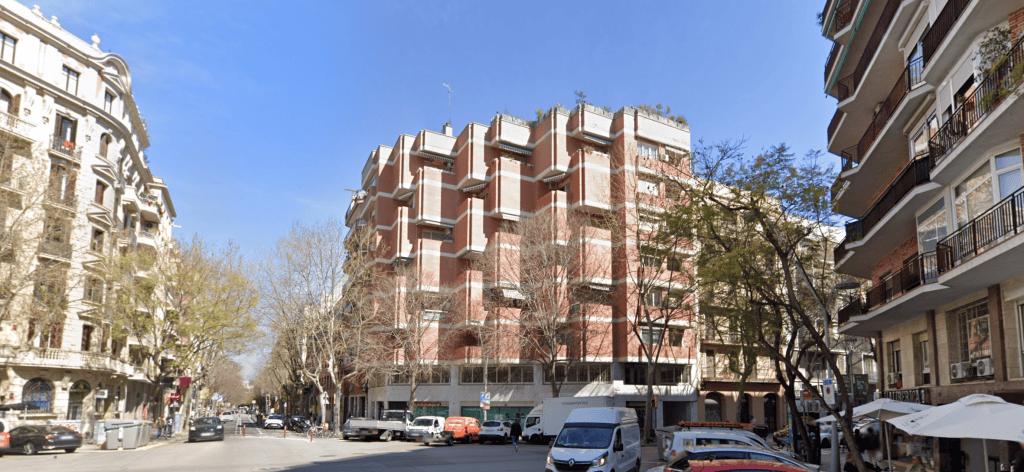
Inconspicuous at first is the apartment building located on the southeast corner of the Carrer de Roger de Flor and the Carrer d’Ausiàs Marc. Easy to miss, in fact, if the intersection was neared in haste; nor probably would what is seen of it right at street level hold one’s attention. Yet when farther away, especially if sunlight does bring out the interest of its stacked construction, then one may want to pause.
Photographed from there, the rhymed pattern of the front comes into its own.
(this and the previous photographs courtesy of Google Maps)
Vertical corners set in small groups of shorter lines, longer horizontal bands along the frontage, weave together rhythmically to render the volumes legible as being several compartments — each distinguished as such — comporting themselves both elegantly and energetically, whose cue is simply the observers’ coming into range.
Salient metaphors for architecture of frozen (erstarrte) or solidified (concrete)8 music might be emended in this case: the built elements coalesce into a troupe whose great mobility is virtual. But how far should this be called dancing? These indications of movement are spelled out mainly for the sake of the better reading. Accordingly, more easily than were its choreography actual, here the onlooker can tell the dancers from the dance, heeding the distances amongst them which grant some distinction to each. So, potent as those metaphors remain, nonetheless they concern all that this edifice turns towards the outside, whereas what transpires within may solicit others or else none at all. Sight unseen, therefore, one should venture not to say anything further about those inward arrangements of space.
“Each,” however, is an idea to tarry over. Elements of architecture in an edifice which separates them from and connects them to one another, become articulate and capable of referring to themselves. Conversely, the singular indefinite pronoun with which they all can do so, each to each — virtually speaking, of course — when examined, this pronoun seems to comprise a set of articulated relations, even to the point of having been built of them, itself thus almost a tiny architectural model.
Such arrangements are evident in the Greek “ἕκαστος,” each, affiliated with the adverb of place “ἑκάς,” far, and indeed compounded from it.9 How this compound may have emerged, there is no need to rehearse; merely to note that the language did take a few steps before the locative adverb entered into the indefinite pronoun, imbuing it too with undertones of the remote. Moreover, distance was traversed in this very process, and again as clarification of the development advanced in stages up till the end of the nineteenth century (in der erklärung des wortes ἕκαστος ist man bis jetzt stufenweise vorwärts gekommen),10 or, to heighten the scholarly irony by other diction, the etymological explanation has gone far and has yet further to go. — Yes, discoveries made in these fields by conscientious researchers, better harvests of the particularly German form of skepticism (die deutsche Form der Skepsis),11 could be paired with laughter, in recognition of the humour of a situation where the object rose up and claimed the provisional last word about the whole inquiry. The philological bemusement seems to indicate that as simple and abstract as this pronoun may be, actually it provides a key to the space that is essential to anyone.
Ἕκαστος, however, is each in a manner inaccessible to everyone. Far enough off from others to be separate, this separation itself must endure if anyone is to enter into connections with them. Only thus do relations become possible, flourish, and persist, while otherwise there might not be a relation at all, but immediacy that is neither more nor less than an indifferent fusion and/or an inarticulate confusion. — A step further and everyone, myself included, could fall into bewildering turbulence and flux which can make me an opponent of those deemed the closest and ally of those farthest away (turbulentes Durcheinander und Wechsel, das mich dem scheinbar Nächsten zum Gegner und zum Bundesgenossen des Fernsten machen kann).12 —
“Each” in the sense of “ἕκαστος” implies eminence and could not exist without it: the pronoun represents a mark of some distinction. “Anyone” may attain distance from others requisite to speak it properly, but “everyone” cannot. Their divergence is made patent by this intercession of “each.”
Furthermore, ἕκαστος is sufficiently ἑκάς from itself for that separation without which there will be no connecting. By definition, as it were, each harbours at least one self-relation, and this number could happen to contain multitudes of them. Distances that each encompasses, give all prepositions roles to play and room. — They are so many! Some are disparaged, others neglected, and a few unspoken. — With, without, through, over, on, in, for, by, beyond, between, beside, beneath, at, as, around, amongst, etc., and first of all against itself it may always be, just as long as its vocabulary still knows the word “each.” Until that point, somehow, even despite itself, when most a tempest, this ensemble of relations never does not harmonise.
Mobility also could be discerned in the word that was the pronoun’s counterpart, “ἑκάς,” before its meaning and reference as an adverb of place narrowed down. Earlier, “ἑκάς” did not only mark the locale but also signified an active separating from it or an object; perhaps this dual function brought the adverb into play when the time came to build the pronoun.13 But I’ve tarried already a while on the topic, and there is other ground to cover, another edifice to address, so this cannot be the place to enter further into the relevant details, though they do provoke thought.
Yet, generally speaking, if the relations within “each” constitute a small model on which to test what one understands of architecture, harmony, and movement, then an idée fixe might stand in the way at the outset. For, in reply to the question why adverbs of place birthed the abstractions that are pronouns, it is easy to cite the pure form of intellectual intuition, space (reine Form der Anschauung, Raum),14 as though the sheer universality of this “pure form” suffices to clarify the judgement that locative terms are themselves quite abstract. But what actually would this ever explain? The ill-considered attempt does only manage to apply the philosophical construct fallaciously, depositing it as a hindrance in the path of inquiries that really are seeking to advance further.
Why should abstract words not contain space, and indeed in more than one way? Entire zones may dwell there. — Such ideas might have led a philosopher to centre vast arguments on a demonstrative pronoun, a novelist to conclude one volume by a disquisition on place-names. There spaces are seen and heard to move, at times to dance, as assemblies read once more while the telling is ongoing; and all this could inspire a few stray passers-by, made bold already by other sources, to watch worlds in miniature amidst groupings traced with force or faintly on a façade: for seldom is it looked at and listened to otherwise, each of its facets or features left as a flower ungathered in a garden, and never used, enjoyments most often withheld.
A modest face was granted to a recent edifice in the neighbourhood of Sarrià, “Casa 1736” by the firm H Arquitectes, whose office is located near Barcelona. The front of an extant building had to remain, by municipal regulation, while the rest was replaced; though an upper storey could be added to it. As has been done, to maximise what the plot did allow, challenging the architects’ ingenuity to spring into action and fulfil the plan of constructing a private dwelling, the task a family in search of a home had requested in the brief. Their dwelling was ready in 2023.
This edifice I had planned to visit, my interest aroused mainly by the presentation of “Casa 1736” in word and image on the architects’ website (not omitting to list the awards the house has won in Spain and abroad), but opportunity enabled me to regard it from within. A welcome chance, because the pictures offered there, as well as those available under other auspices and even a video, while allowing an initial perception of the work and helpful subsequently as aides to the memory, still cannot replicate an experience of it in its full three dimensions. For, to take the most obvious feature, inspired by inward-turned domestic architecture in Rome, the storeys are built around an atrium configured virtually already as an inner courtyard or an actual one whenever the window above is mechanically retracted. Meanwhile, the architectural idiom eschews decoration and opts for simplicity in materials, with particular care given the millwork, designed and done with skill. (The interior calls to mind some projects of a Madrid firm, Plantea Estudio.)
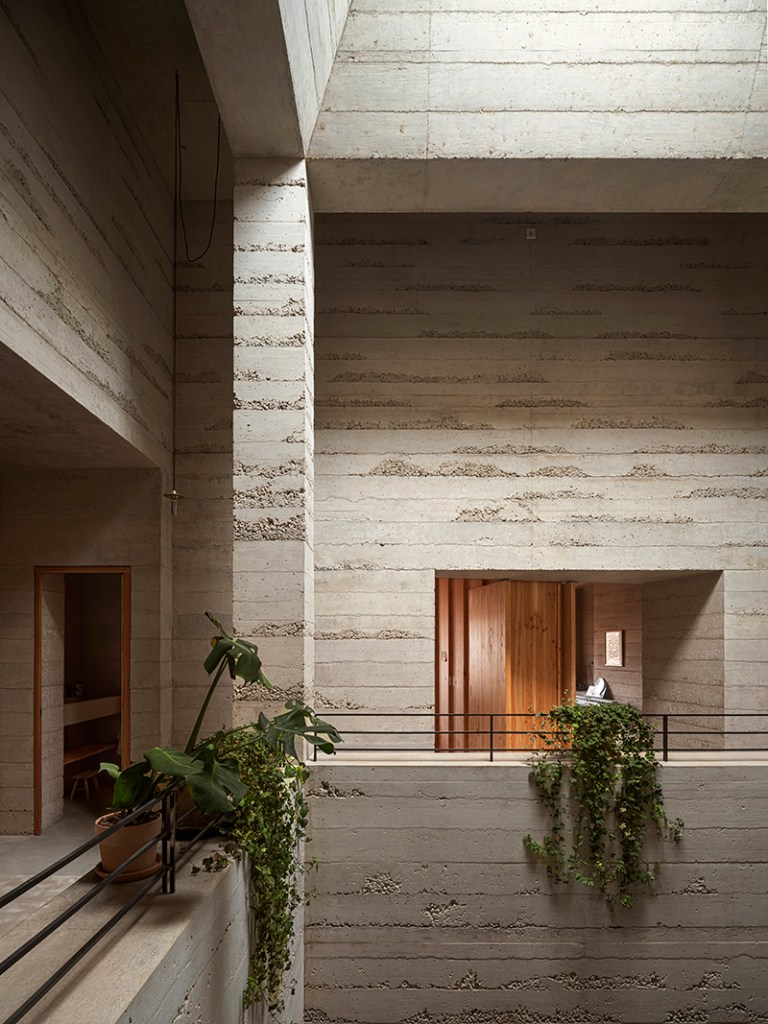
“Casa 1736” abounds in brutalism, and the handling of concrete appears nowhere better than in the building’s heart. Two photographs which illustrate this well provide an impression of the room during the daytime, lit naturally from above, although the scale of it as represented in two dimensions strikes the eyes as being rather more imposing than the place itself feels when experienced in three.

(photographs courtesy of the architects)
The first of these photographs illustrates the atrium on the ground storey, while the second gives a nearer view of the cloister overlooking the inner courtyard from all four sides. Yes, depending on where one stands in this room, either side of its dual character seems more evident than the other, though without banishing it. Within these walls they co-exist, and once aware of this one may comprehend better the mixed typology which has instilled its significance into the edifice’s central space.
This room brings together two Roman models: the sacrum and the sanctum.
On the ground storey, open to the light above, the old Roman sacrum evidently is the model, a locale set apart from life’s ordinary activities, whose character was not sacred (horribly misused word!) but rather, a much more fitting term, sacral. Some of the ancient solemnity lives again in the atrium of “Casa 1736” by virtue of the architecture’s forms and materials, when the room is regarded upwards, from the ground storey: a mood conveyed at least to a degree by the first photograph.
From the cloister, peering down, this courtyard recalls the sanctum, a structure built by Romans principally to enlist powers inherent in earth towards productive ends, in the fields, around cities, even inside the homes, edifices on whose stable foundations much depended. Though the term extended broadly, it seems likely that in classical antiquity “the immobile” was properly the underlying meaning of “sanctum” (ἀκίνητον bildet die eigentliche Grundbedeutung von sanctum).15
Settled, solemn, stately — qualities of the room’s harmonious duality. They could transfer to the residents in turn, within this house built in view of the demands of shelter much like the architecture of caves (com en una arquitectura excavada), as the architects aver. Ensconced here, amidst such an influence in a space devised as both sanctum and sacrum, with concrete walls on all sides, columns rising in every corner, cloister and skylight above, each dweller might feel a bit of invulnerability, granted by the architecture somewhat as respect for his office once had shielded the Roman tribune (sacroquesanctum).16 — A transposition to reflect on further.
Right at the heart of this building’s immobile music, what role might be played by music’s mobile architecture? What sounds would befit the space? How for example would a grand piano fare, were it rolled into the main room? — Perhaps in answers less can also be more. — The concrete remains to be impregnated (imprägniert).17 Rough though it be, still the material stands exposed to time, lacks a certain future; how better to seal it against the one and seed it with the other, than by a most inspired and least material activity, good music?
17 Notes
- Adolf Loos, “Ornament und verbrechen.” ↩
- Vide Jacob Burckhardt, Die Cultur der Renaissance in Italien, Erster Abschnitt (“Der Staat als Kunstwerk”). ↩
- Justin Murphy, Tweet, February 5, 2025. ↩
- Remark by Bill Clinton quoted in James Rainey, “Democratic elder and former President Clinton, the ‘man from Hope,’ calls for a president of ‘joy’.” ↩
- Stephen Spender, The Year of the Young Rebels, “The University as Agora,” “The University City State.” ↩
- Jorge Luis Borges, Fervor de Buenos Aires, “Remordimiento por cualquier muerte.” ↩
- Gilles Deleuze, Périclès et Verdi. ↩
- Friedrich Wilhelm Joseph Schelling, Philosophie der Kunst, pt. ii, sec. iv, §§ 116 (numbered 117 in error) and 107, respectively. ↩
- Vide Pierre Chantraine, Dictionnaire étymologique de la langue grecque, vol. ii, s.vv. “ἑκάς” (adverb) and “ἕκαστος.” ↩
- Jakob Wackernagel, “Miscellen zur griechischen grammatik,” 14. ↩
- Friedrich Nietzsche, Jenseits von Gut und Böse, Sechstes Hauptstück, 209. ↩
- Karl Jaspers, Die geistige Situation der Zeit, v, 1. ↩
- Vide Wackernagel, “Miscellen,” 14. ↩
- Wilhelm von Humboldt, “Über die Verwandtschaft der Ortsadverbien mit dem Pronomen in einigen Sprachen.” ↩
- Johann Jakob Bachofen, Versuch über die Gräbersymbolik der Alten, “Die drei Mysterien-Eier,” § 13. ↩
- Pliny the Elder, Naturalis historia, bk. vii, ch. xliv. ↩
- Loos, “Das Mysterium der Akustik.” ↩