Now entered into their hundredth year are two brief texts of 1924. When dusted off, after a century, at the outset each appears to be a mere vignette, yet then not the sheen of insignificance is met with, but something like fingers tracing a small figure in the air, less a keyhole than a window onto a tiny scene; looking through it, the longer these views are focused on, and indeed, one may surmise, prior to the writing-up both texts’ authors did dwell on them at length, the further will they enlarge and elongate themselves out of the ordinary: interrupting in effect and even suspending its usual heedlessness.
Older in print by one day than the other, is “Zerstreutes Hinausschaun,” one of the last items published during the lifetime of Franz Kafka. This text, its title says on first perusal, will depict a brief and absent-minded glance out — out of a window on a spring day, as is said in the middle of the initial paragraph’s second sentence. That hints of the arrival of better weeks are perceivably there, though a reader would eagerly infer it, cannot be assumed, for this scene the sentence had only imbued with an early morning grey, and such a matinal condition might or might not presage a change of season. Accordingly, albeit with a slight weight, this uncertainty rests upon the outlooker, and that is why his gaze, one may conjecture, embodies enough indecision for the title to have called it “distracted” (zerstreut).
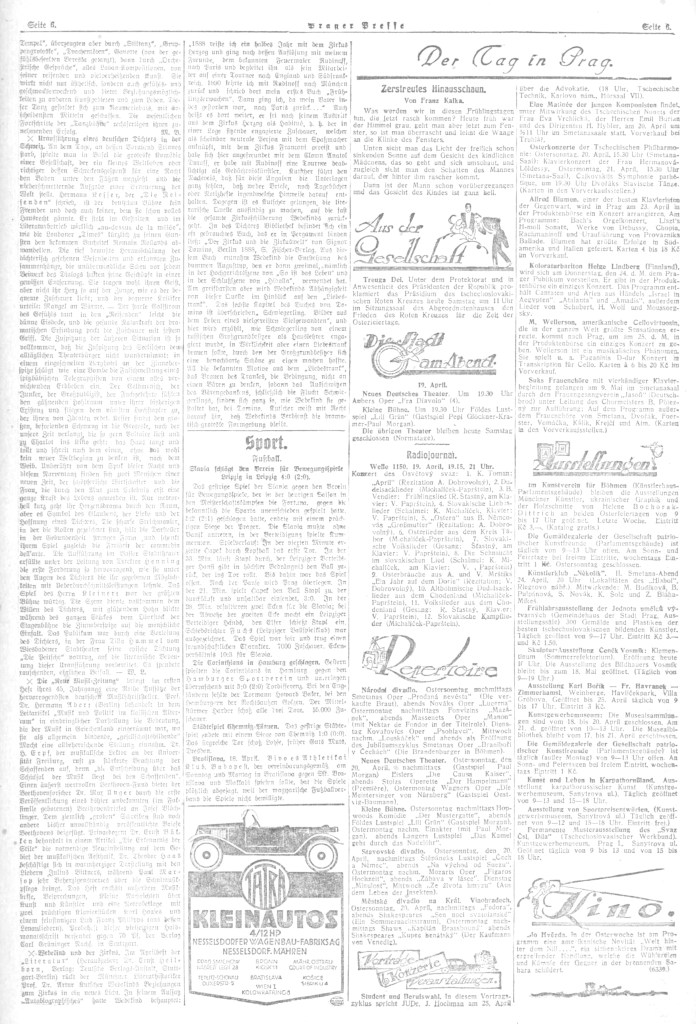
Examining the word “zerstreut,” the closest translation would be “dispersed” or, better still, “scattered,” as the force of the verb at its root, “streuen,” cognate to the English “strew,” has by no means dissipated (or: been dissipated) in the profusion of German terms which play variations upon it. With this source of the word’s meaning borne in mind, readers may notice more than a single distinct sense in which the look out the window is called “scattered.” Most obviously the outlooker, before he became one, having gone across the room, remained under the sway of absent-mindedness, his powers of concentration less than fully engaged, and in this suggestible state the window drew him to it: then the looking-out he initiated there, partakes of the earlier movements of relative absence of mind while also terminating them. Finally, thus, they themselves are dispersed — by a rather more focused act of looking which itself is scattered, though in another usage of the term. For, grammatically speaking, this regard toward the outside is something like an object he strews, in an action now evincing on his part a more purposive frame of mind. Recall how an intellect which did consent while its attentive powers were disengaged, can also turn and pull itself together for the sake of an active moment of seeing, potency which might then be imparted to that which sight notices once brought into the foreground by perception, cast as if it were a word or a seed.*
* Spelling out processes of mind better left untouched due to their obviousness (or else their own depths), could weary readers with an awful banality. — While even to point out this, in turn, seems banal. — Banalisms, if such a term does or should exist at all, can be avoided less easily than one would prefer. Caveant cogitatores!
Accent is already placed on activity in the text’s first sentence, albeit by means of a question whose tone may well suggest it to be either rhetorical or ironic or both. And not only on that, but also on the season’s rapid arrival which occasions the query. How very insistent an occasion can prove, this one begins to feel on such a promising spring day. Powers of vision might quicken in response; if any vivifying force is latent in them, now after some period of dormancy it could emerge again.
Early days it is still, however, and one of the issues in the awakening the spring may well foment — regarding these matters under the aspect of their symbolism — namely, the rumblings of possibility lodged in the vehicle of action par excellence, that elusive pronoun we (wir), is given expression once only, in the question posed with wistfulness at the outset. Yet even so, if one listens closely to the diction an announcement of them might be detected in advance, in the evocative auditory impetus within the very sound of the word “rasch,” whether occurring by itself as an adverb, signifying quickly, or in the derivate “überrascht,” surprised. Without an onrushing spring or speed, action will not do nor be what it should. Velocity itself contributes some energy to that mainstay of all action which is the feeling of a we.
Pressing his cheek to the windowpane, below on the street, brushed by the rays of late-afternoon sun the outlooker espies a small chiaroscuro scene. Or has the sight been brought into existence by the glance from above, imaginarily, this minimum of an occurrence assembled mainly from scattered memories of paintings he once saw? — Regardless, there a young girl is seen walking along and looking around, the light on her face, though at the same time some shadows too, cast by a man she observes walking behind her whose pace is faster than hers, someone no sooner noticed than he already has passed on ahead and disappeared from view.
Whether a trace of menace ran through such a brief incident, or if it were only a figment, who is the outlooker to aver, much less the reader? Be that as it may, now he sees the girl again alone on the street, in an innocent moment, her face awash in the afternoon light which renders it in that very instant quite clear (ganz hell).
“Hell” is one of the German words which mean roughly the opposite of what an unwitting English ear would assume at first. The lucidity and brightness it denotes are addressed first and foremost to the eyes, though earlier in its history the word referred mainly to acoustic clarity, and a reminiscence of this informs the term taken for the second vignette’s title: “Hellhörigkeit,” by Robert Musil.

On its face the word bespeaks acuity of ear, an ability to hear things very clearly, and amongst them possibly echoes or anticipations, above and beyond the sounds of all that which is nearby.* And yet, stemming from the underside of the German term one may perceive the implication that this is an acoustic sensitivity which can serve to tie the hearer to that which he would hear: a faculty developing at the price of some more involuntary degree of his adherence, even a bondage to the sounds themselves. Or at least with it there might arise a vested interest in them.
* Comparably, the German language calls “Hellseher” those people who attribute clairvoyant ability to themselves.
The scene, the narrator says (to whom?), describes an assignation in a hotel room, perhaps of an amorous nature, though this point remains less than clear. He feels somewhat ill, it may be a little cold or spot of fever. Already he has tucked himself in, his eyes shut or unseeing, and it is while waiting for her that his ears become keen, sharpened perhaps as though in compensation by his poor state. She busies herself here and there, extending the process of undressing to a considerable length, which his aural imagination at its now heightened level positively drives him to begin to analyse and thus to stretch out even further. He hardly can any longer say what are the things he hears, but the experience of hearing all of it would overwhelm him, did he not at least seek to distinguish their various noises. His manner of recounting all this, in turn, comprises moments whose awkward jostling is itself not unaccompanied by a slightly comical sound, possibly due to the febrile warmth that animates from within the ideas he does attempt to form of those things, minimal idea-images which his imagination, over-heated, fashions into something like automata in an all-too-long interior performance (Vorstellung).
His thoughts both pertain to and address her; amidst a surfeit of the familiar second-person, between the gaps readers also are invited to peep in. Yet would a reader, could we, they, anyone, the pronouns which haunt the reading public and its expectant opinions, then or now, feel fully certain that it really was she he had in mind? Behind her, as interlocutors each made even stranger by his “Du,” there perhaps are moments of the performance themselves, both singly and together. — These performers tend to steal the show; it may be by them more than with her per se, his attention enthralled, ear attuned, that he is preoccupied while waiting.
By now she has moved on to the sink, readying herself for bed; and it is at this juncture in the proceedings (trials may indeed take any number of forms) that he ponders how even the acts seemingly most simple contain a — evocative phrase — hundred tiny actions (hundert kleine Handlungen). Perplexing is the automatism in whose absence human behaviour would be nothing at all! Though he reflects on it without wanting or being able to enter far into such a labyrinth; the touch of fever which at least has helped to lead him there, may also prompt him to desist from further steps. Stationary after its “Don’t!,” he notes how quickly those actions are passing by, and is inclined to assure her (?) I know you’re hurrying on my account (ich weiß, daß Du dich meinethalben beeilst). “There’s no need not to rush as long as you would like,” he might actually be saying, in the privacy of his consciousness, with a wry raised brow: finally, for him the wait seems to be worthier than the encounter one may suppose him to have been waiting for. This interval itself he may prefer to see tarry awhile and for more than a while; how to avoid a passage to the act, what ever it were to be, as a practical question under the circumstances, might impinge upon him more insistently than he really cared to grant, and thus he would hearken with greater alacrity to the sounds than otherwise. In the case of an auditor such as he, the acoustic dimension takes shape as a zone of deferral.
Heeding the sound of it all to prevent any one from becoming too clear or allowing some other to lead him on — that could be a trick his fever (what ever its degree of reality) played on the inclination called “Hellhörigkeit.” A little tactic of reluctance, delving into sonic minutiæ as if they were very large things, the better to turn that condition’s own impetus back against it, with the aim of saving him now at nearly the last moment from an entanglement he had not shunned, though avoidance were well-advised, so alluring had been its prospect.
How will the gambit play out? Its result this vignette leaves unspoken; no more than the stakes have been intimated. — The enlargements that aural experience is able to bring about, extruding sounds from their surroundings, also tend to impart a semblance of necessity to the significant connections which become clearer even if perfect clarity of the parts is eschewed; and then acuteness of ear may spring in to neutralise its own consequence. Resonant illusions which it tends to foster, it itself can hear through and in so doing dispel, perhaps even at just the right time.