Plentiful are the delights offered to the eyes, and their ears, in the exhibition on view for around another month at the Centro Centro in Madrid, of works by the Impressionist, and some of his friends, from the Musée Marmottan.
Claude Monet should need no introduction; thoughtfully the exhibition does include items that illuminate the artist and his life on certain points. Proceeding through it, one finds the portrait from 1867 of him by Carolus-Duran, a hint of bemusement in his expression; the curators’ summarising of his opting for the newly-invented synthetic pigments whose chromatic values were more stable and permanent; their explication of the ocular deterioration he experienced in his last decade, of the consequences it had upon his artistic vision, and of the medical steps taken to minimise the problem (also on display is his pair of prescription spectacles with their yellow glass lenses); and, not least, an account of the touching letters in which concern for his recovery was kindly shown by Clemenceau.
Photographs of his home and especially of his gardens in Giverny in flower, are mounted amply throughout the galleries: they do awaken or refresh the desire to visit or else revisit if only by a voluntary excursion in memory the place, as to it nothing less than an actual encounter, preferably in spring or the first weeks of summer, will begin to do justice.
Yet to look once more at, or to see for the first time, some of the artist’s early works, scenes where he evinces great skill in presenting the bathers and beach-goers at the seaside in Trouville, in 1870, or a young family strolling through the fields around Argenteuil, prepared for a bit of rain, five years later, is also quite affecting. And in this mood one can understand: not only did he with his “impressions” seek to eternalise the qualities of light and atmosphere at particular moments of the day, but also to evoke something of the feeling of different conditions of moisture, which, giving the matter a little thought, might be found to pose another challenge, perhaps even more difficult than the other. He met it (this now seems clear) by including at a few well-chosen spots impastos which don’t have anything viscous about them or stagnant, but rather do positively glisten, as though they were freely fluid and wet — as a painter friend of mine remarked to me.
The exhibition as a whole was lit with great if not perfect care, so that these small, virtually liquid protrusions could be noticed as such, being given just the right kind of shading around them to make them jut forwards from the surface. In some cases, one might even spend hours contemplating them, so suggestive are they . . .
For rain’s other condition and its inherent lightness, in both senses of the word, Monet also evinces a subtle feeling. Implying it is “Le Train dans la neige. La Locomotive” of 1875, in which the quality might be discerned even in those areas where the snow has been most tread underfoot by the travellers.
Amidst those surroundings, how hotly, how intently or intensely does that part of the locomotive which is most a visage, most a pair of eyes, stand out, powerful and raring to move on! — How frozen would a viewer’s mind have to be, ever to forget the impression made by this scene?
Burning red was not the artist’s favourite amongst his pigments, but neither did he eschew it, as this painting shows.
Several decades further on, during and after the World War, in some it blazes so prominently and with such force that it’s hard not to think of fire — that is, the element which devastated large sectors of the land in those years, amongst them many tracts eminently suited to cultivation. (Some areas have never recovered from it.) The nexus of cultivator and cultivated, without which “humanity” may be but an empty word,* was stretched nearly to breaking — such was commonly the assessment from a safer distance, while regarded from close up, how could one candidly say it had not been torn asunder? And so very far from the frontlines, after all, his gardens in Giverny were not. So, when he reflected upon the carnage (how at times could he not have), what must the artist have felt and thought? Would not, at least in some moods, the measure of solace found in his rapport with the parcels of nature he painted and cultivated — painted in order to cultivate it, cultivated in order to paint it — have become stricken with disquiet?
* This significant inner linkage was touched on in an earlier essay.
In the long horizontal “Nymphéas” of 1917 to 1919, the pond and its banks are rendered by isolated strokes of the brush, the whole now manifesting the visual integrity of a piece of writing or a musical score: the canvas is handled as though it were a sheet of paper, and the style of this late work is taken further towards the abstract, the region of art where saying abstraction almost already says subtraction.
Though I should have preferred to omit all illustrations, nonetheless, because he created several paintings under this same title during those years, and also as a mnemonic aide, a photograph of this one has to be included: I trust it will be understood that no reproduction could possibly hope to do justice to the work, neither as regards the colours, nor the other painterly excellences.

This is a painting one must see with one’s own eyes — and listen to with their ears. For in it the essential has been abstracted from everything else — or it is the latter which was subtracted. What remains, and a reproduction only poorly conveys, are notations transcribed for a song. An epitaph for the nexus of cultivated human life, ripped up in the World War, that it is — but still it is there for the singing.
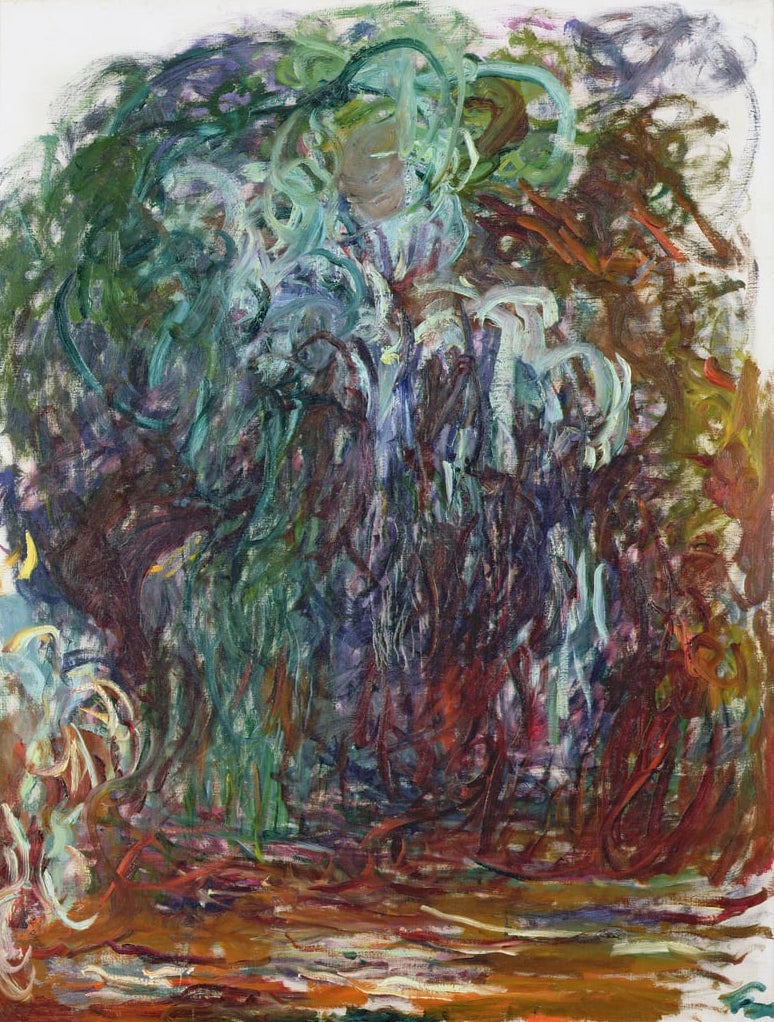
In the “Saule pleureur” of 1921-22, one sees brushstrokes in a more compact mass, and an influence exerted upon the mood of the whole by the colour of burning red, while this image has a face: thus I shall conclude with what seems patently to be an aural picture of lamentation. (Like the previous work, this too has a title shared with others, so to avoid confusion I shall also include a photograph of it, though insisting on the same caveat.)