Burdensome heaviness of the heat, midway through the summer months, prompts at least a desire to evade it somehow, though if this wish is translated, transposed into a continuous stream of thinking, the languor from which it springs most likely can still be heard, albeit softly: the less-than-tight or else half-taut tones that result, come from the strumming of thoughts with a looser touch than at other times. Traces of ease — when the flow of thoughts is more æstival — those who give it expression with the right gusto seek less often to efface fully. Some nonchalance is precious, while relaxation for its part does not now lack raisons d’être.
Sprezzatura as befits the summer, encountered when one delves into someone else’s ideas, be they expressed in words or through other modes, or dances around those one deems to be one’s own, itself provides an interesting topic of reflection. — Deliberate artlessness that makes it all look so easy, is evinced by a set of paintings at the Guggenheim Museum in Bilbao, “Nine Discourses on Commodus,” by Cy Twombly, which last month I had an opportunity to see. His canvases turn sixty this year, yet the interval has not obscured the human figures comprised therein or masked their legibility, to parse which the work’s title offers the key; nor have the rhythms of each individually and of their sequence been drowned out by the voluminous noise of succeeding decades. Still today, on each of them singly, and in the ensemble too, stretching along the wall and by implication projecting forth from it, movement and indeed the suggestion of sound is described by painterly means. An extemporaneous concert is the virtual result, and in the gallery this Twomblean music has the floor nearly to itself, precluding therewith the strife of inordinate contests which, to mention one of its likely consequences, would chase out the Valéreans, they whose æsthetic antennæ induce in them allergies to any inhumane and incongruous proximity imposed upon the works.
Those most sensitive of humanitarian æsthetes, too, then, are afforded a chance to contemplate this work of art. On their side, its nine panels are not exactly shy. What do they offer to the eyes and the ears? Even without the title as a key, one may infer they concern themselves with execution — I do not mean their own, as though they formed mainly a consummate study in self-referentiality. No, the mastery shown is depicted in action, where not the qualities of someone’s horrible deeds are specified by the titling, but simply the identity of their perpetrator. Thus this omnibus title serves as something like a forensic caption, placed under the misdeeds of one of the worst amongst Rome’s rulers, to whose name there has accrued little but his atrocities and perversions. What has been recorded of him by the historians of antiquity, over against the damnatio memoriæ pronounced after his own violent demise, then rescinded, was first and foremost the cruelties he inflicted upon innumerable victims. A representative few of these horrors it is which Twombly’s nine works let one see and hear — shorn of irrelevant detail.*
* Details, in such a case, serve to turn attention away from the cruel act itself, which after all is what one should ponder. From that they distract; so Twombly did well to omit them as far as he could. — For the aberrant life of this Emperor, consult Ælius Lampridius, and Cassius Dio (Roman History, bk. lxxiii).
Individuals ripped asunder, by the eviscerations and dismemberments with which Commodus again and again tantalised his desire for cruelty, left the matter of their tiny, fragile human bodies on the faceless walls against which they were killed, in imprints of gore spattering there. The entirety of these ghastly scenes was set up deliberately by him: he enacted them as spectacles, though held in narrower confines, counterparts to his exploits before everyone’s eyes in the arena; and thus they are illustrated by this ensemble of nine images.*
* This set of works, in accord with their maker’s intention, as it does seem to decipher itself, should be taken not as commemorating a victimage, nor as celebrating the latter in some pseudo-Sadean fashion, but rather as issuing a caution about the empire of the libido dominandi, an alarm raised by images, avoiding nearly all the means of narrative. — But into conjectures of an artist’s intent or aim behind the making of these panels, here I need not enter further.
Though this sequence of paintings neither describes nor narrates, or at least does not appear obviously to do either the one or the other, it does abound in figuration, is replete with indications of movement, of violent motions: to say it once more, one sees substances, especially fluids, striking walls and dripping to the ground . . . By these visceral blots and bloody streaks, inferentially, other, still living figures, off-scene, are, in a word, co-posited: situated disturbingly near the vantage-points where one oneself stands, when one looks at these images on the wall. The spots, moreover, at which one listens to them in their sequence, intent upon such noises as kinetic collisions tend to make, those awful sounds of horror spelled out with onomatopoeias (where language grasps the chance to show off its powers). And also, of course, the frightful groans of the dying as these themselves die down.
Discomfited — if one is not a voyeur or that type’s aural counterpart, or some other variety of connoisseur of the appalling — a visitor may well opt to depart before long from the gallery. Yet this set of nine “discourses,” in accordance with their generic designation, seem patently to call forth one or two questions to which some at least amongst their audience might later return.
Aural pleasure: what role, if any, was played by it when the tyrant sought to gratify his desire for cruelty over and over again, either in settings more restricted, or, within the arena, before the remnants of that which once had been the SPQR?
He fancied himself a gladiator; but had he somehow also managed to attain proficiency as a sculptor or inventor, would he then have devised another and more intricate bronze bull, in order to elicit concerts from his victims as they were roasted in it, securing thereby his notoriety in a further endeavour as well?*
* Surely it can be asked how far he might have remembered the fate of Perilaus, who not only built the horrible device, but became the first on whom it was tested, by the express order of the Phalaris to whom it was given. — This denouement is written of pithily by Diodorus Siculus (Bibliotheca historica, bk. ix, 18). — Probably, however, heedfulness cannot be ascribed seriously to the tyrant in Rome.
Commodus chased after cruelty, in secret or with brazen openness, and was adept at shifting the fury which the reigning conditions aroused amongst the populace onto the instruments he chose for the Empire’s administration, the few who managed to win his esteem: until their downfall became expedient. By such a temporary delegation he could maximise his time for the pursuits that did most entrance him. Meanwhile, under such a titular ruler whose focus lay elsewhere and his precarious succession of favourites, the hands of their underlings, the next couple of layers of administrators, were often untied. Hence, all in all, these tacit distributions of actual power within the Empire ensured a tumultuous stability for years, almost thirteen as it happened; then the moment came when its negligent head could no longer be tolerated by his nearest counterparts; at last this life was snuffed out, a slaying in the deciding of which presumably were commingled the individual need of self-preservation and a greater necessity of Rome’s raison d’état.
Sixty years ago, this crucial episode of Roman history came across with some quotient of eerie resonance, in the wake of a spectacular political murder behind which the trigger-finger of the state within the state was immediately surmised.* Thus the correlation lent a sharper point to these “Nine Discourses” than they otherwise would ever have manifested, kinetically and aurally, while decades later this historical sound of a rhyme in the background remains audible, especially if one concentrates on the main similarity and does not stray into the zones of detail where everything factual soon is rendered opaque and uninteresting (nor into the mazes of chatter theoretical or empirical about the artist’s or the art’s intention).
* Recently this same suspicion has been uttered once again, in the political arena, or rather, within what still exists of it under present conditions. Bearing in mind all the factors which have come together to deposit us at the point where we now find ourselves, one really should not wonder at the vehemence of its statement.
Granted, those zones of obscurity often prove difficult to circumvent in practice, for many are the routes by which one can end up there, willingly or otherwise; especially when the abundance of all manner of “cold cases” itself may look as though it were designed to inflict upon the unwary a corrosive suspicion of anything and everything under the sun, and then . . . ? This is a major pitfall now.
Not including the extraneous details that would lay inordinate burdens upon one’s attention, which can only ever be quite a finite power of the mind, after all, is precisely what these nine paintings do, and therefore this artist’s self-limitation also served a basic purpose: to initiate a rapport between the “discourses” and an audience and to keep it open, that they obtain a sufficient hearing, without being thwarted by the interference of irrelevancies. Such an effort is already significant.
Furthermore, because in these paintings the avoidance of inessential details has been exemplified, tangibly, as it were, amongst the transmissions sent through this discursive channel to the audience, prominent is the example of that deliberate self-limitation itself, thereby commended as a practice of ἄσκησις for the mind, more specifically, the power of judgement, which might benefit by embracing this disposition in all freedom. (Nowhere, however, is there a guarantee this message will arrive and be properly understood.) Hence the opting for self-limitation does not merely constitute a pre-condition of these works’ “discourse.” Apart from that enabling function, it also furnishes one of the items of interest, one amongst the topics for reflection the “discourse” proposes to those who are listening; and by dint of the thinking which then could result, the baleful temptation of inordinate detail might, just possibly, be neutralised. Hardly an unimportant consequence!
Ἄσκησις and studied artlessness (sprezzatura) are also encountered in the work of a painter working today in Madrid and elsewhere in the country and abroad, Eloy Arribas. Moreover, his too emphasise the character of their musicality.
This point about the music, one of his first shows, from March through May 2016 at the Domus Artium 2002 in Salamanca, already conveyed. “Bonita demolición” the show was called, more than hinting that these works of art are correlate to a particular sort of present tense, that restricted portion of time as yet unconfiscated by the wholesale theft of all which otherwise would have come, as the young see it, those who realise they must skirt and weave swiftly around debris strewn in their ways by this ongoing expropriation. Thus, as far as each is able, they all bypass or even surmount the injustice of it — though imperfectly, for as “una gigantesca estafa de la que somos víctimas y por la que no podemos demandar nuestros derechos” it looms up again and again before them to evade. (I quote from the text of introduction to the show, which seeks to express the common sentiment of frustration, shared evidently by the artist.) From the persistence of this swindle (estafa), what is it which generally appears to follow next — whether by causation or by correlation, what importance could that explanatory distinction have here? In consequence of the brute fact which they meet nearly at every turn (much as do others of like mind), when time steals away, obstacles are left behind of virtually a three-dimensional heft and weight. How may this rubble be avoided? Skill in circumvention is requisite, an ability broadly speaking kinetic, one whose sense of balance, poise, rhythm is not inert but can be trained into proficiency; and more than merely an option, this practice amounts to an urgent need, over against all these problems. They were being deposited rapidly indeed, at the moment of that early show of Arribas’ work, hence a quickness of response, a swift dexterity was needful; moreover, clearly, even then each of these two speeds was not to be reckoned as a constant, but understood as a quantum in a process of acceleration. How much more frenetic their onrush in tandem has gotten, several years on! Where the unrest of today will go, perhaps those few who now hold their lanterns, barrels, and canines in reserve may best imagine; but for the moment, one does well to heed those who, like him, have taught themselves how the theft of their futures should be contended with. By way of response, the kinetic ease they study to acquire — in art, in life, in music — lends forthright emphasis whenever they say in effect, through this or that channel, Dance while you can! Or, as this note of admonition was pitched back then: “No llegues tarde que esto se acaba.”1
Not merely the individual works in that show, but a number of their installations also convey an idea of how he handles the quandaries of beginning, of creating anything at all, amidst the rubble of the present. A dose of nonchalant humour did contribute to the placement of some relative to the others. (Although, to be sure, to whom exactly the choices should be ascribed, does remain a bit of a question.) Today these witty juxtapositions may still be savoured, for the interested visitor can even now opt to take a virtual tour around the galleries, a possibility kindly maintained by the institution which berthed “Bonita demolición.”
With élan, several of these works depict musical instruments, groups, and locales, while the elements of others, while they may appear to be arranged as though by improvisation, were in fact composed with thoughtful eyes/ears for the rhythm they heed in two dimensions, in some cases, or for the kineticism that orients itself within three, agility that the work “Aventuras de Lui en la ciudad” suggests particularly well by its embodiment of depth — although this spatial quality does not readily appear in the illustration selected for the publication accompanying the exhibition, whereas in the more adequate photograph provided on the webpage of the show, it does actually come forward (perhaps a bit of backlighting was used). Accordingly, for the sake of convenience, I shall include the latter.
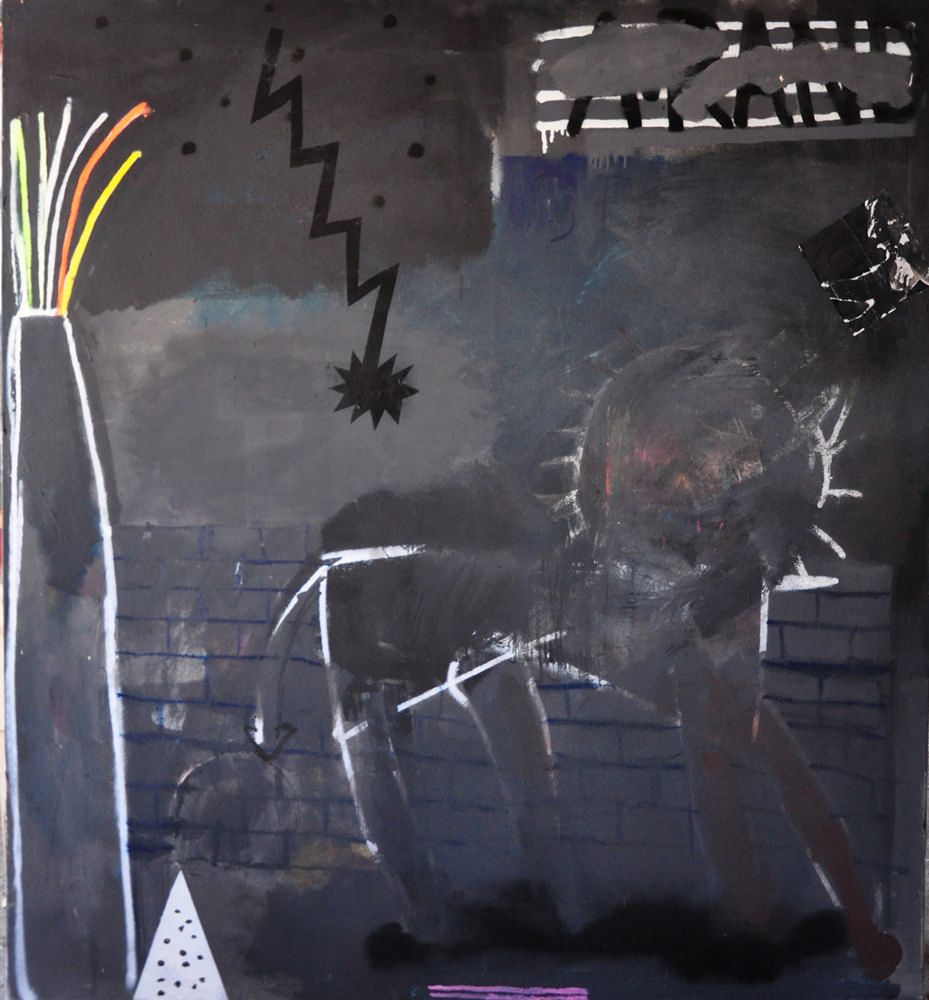
Notably running across the lower half of the picture is the wall, which, while I shall not belabour its nor the other elements’ various meanings, does seem to demarcate an existential limit, from which the main figure in the foreground has turned away: so summarised, this painting imagines the encountering of time by today’s youth, as outlined in the text which introduced the show as a whole. But then, if that summary is plausible, not an elucidation of pictorial form is called for, but that quite different mode of understanding, an appreciation of the studied ease of the rhythms in the work, that is, of the music it transmits by visual means.*
* Even so, a conversation with the painting need not be ruled out. Indeed, when one looks closely, its musicality might prompt a whimsical question such as this: what sound is made by the forlorn — cat? centaur? — outlined in the foreground?
Without underplaying the artist’s development, nor the changes his art has rung during the interval, from this early painting to the works displayed this year at the Curators Room in Amsterdam, in a show entitled “Antología de canciones / Anthology of Songs,” there is evident continuity. With this new round, musicality plays an even more primary role, obviously.
Noteworthy, also, is the opting for light or white backgrounds, which moves the figures towards us further than the earlier painting had done. Emphasis was placed on the etching which made them, such that one may see these characters as having been incised into solid substrates, akin to graffiti in the venerable sense of the term, designs inscribed with styli or simple pen-knives. Implicitly, then, these furrows were meant to endure and, what is more, have virtually already lasted for a long time, as though to insist, in a perpetual present tense, each is old.
If, with these works too, beautiful demolition was a factor, here the recourse aimed to make room for the perdurance of the outlines of things. What things are these? (One might also call them essences.) Perhaps the artist’s skill will be honoured by the answer, They are songs! — ¡Son canciones!
Studied artlessness neglects details, to distill the songs. How easily these collections of figures whittled in outline recite theirs, the tune each is to sing; how well they mark the music, fixing that which one should hope no currents will deface.
Such, it seems to me, regarding them from a distance (I did not see the show itself), is the mood these most recent paintings can transmit.
Somewhat at variance is the feeling conveyed by “Tonada de luna llena,” composed by the artist in 2020. Here the human figure is absent, while projecting from the canvas are relief casts of a few things, and affixed to it a drawing as well as papers which serve to cover over some other sectors. Hence, in this instance, when backlit, Arribas’ work changes its appearance quite considerably.

(photograph courtesy of Galería Herrero de Tejada, Madrid)
Although, as the artist has put the matter, the cast reliefs of fruits and vegetables in this work and others in the same series (in this one it is a slice of watermelon which hovers prominently towards the top) are intended to invoke the particular meanings they have been given in the symbolism common to Flamenco music, music by which these paintings of his were especially closely inspired — and such correspondences would be interesting indeed to delve into — nonetheless, that must remain a task for another occasion. Nor, comparably, need the branches modelled here (or, in other works in the series, bricks and construction materials) now be inquired into, as regards what they may signify. No, apart from these rhythms of its pictorial elements, sonically there is something else; this painting may have distinctly more to suggest about experiences that are specifically acoustic. So, with this hint, briefly, I shall close (since the day’s languor is pressing).
In the lyrics (by Simón Díaz, 1928-2014) of the song from which the title is drawn, the resplendent moon appears above all to be an unblinking stare:
La luna me está mirando
Yo no sé lo que me ve
— this look is troublesome! But that to which a Why? is addressed, surely one takes more for an ear than for an eye?
1 Note
- Marta Álvarez, “Bonita demolición.” ↩