After a three-month run at the Museo Thyssen-Bornemisza, an exhibition devoted to “Proust and the Fine Arts” is one to prolong in thought, fittingly, in a tribute of recollection. This is tendered even more willingly than it otherwise might be, when as now the situation in his home city bears the marks of a bitter humour, if only when viewed by outsiders. Scenarios witnessed before are enacted according to a script anything but new: pretexts differ, the text is roughly the same. But then, the scene being Paris, if these shows are like streets one strolled before, how would the historically observant avoid the uneven paving-stones? Not to trip over them (grateful perhaps that they are not yet buried by the wasteland sands to come), no, but at least making second-best of this moment of unsteadiness to look around: to intuit what it was like when the polity underwent the strife still audible in the volumes of the novel, twenty and more years afterwards.* Hence, generally speaking, this year 2025 whatever the locale remains very far off from him and his work, while one is, or rather, some of us are set nearby again, as concerns matters from which (may it not so occur!) most serious consequences are readied to ensue.
* Timed fortuitously, as it happens, now in Paris is the exhibition “Alfred Dreyfus. Vérité et justice,” on view at the Musée d’art et d’histoire du Judaïsme, paired with a catalogue.
Under the aspect of revisiting (in effect the art-exhibition declares): this offers a route to approach the works.1 Where no first “visit” ever did take place, a “revisit” may open a portal to discern that fleeting quality which is a little bit melancholic (ein wenig melancholisch), and more thought-provoking, an old rose-scented hint of the irretrievable (ein alter kleiner Rosengeruch des Unwiederbringlichen).2 If such aromas even exist, other than as the hallucination of those who again find they’ve too much time on their hands, then as out of reach as this thing someone never knew to begin with does remain, a semblance thereof may nonetheless not melt altogether into air but instead waft forth on it and be caught by the — nose of the intellect. Strangely enough, not only with the mind’s eye, therefore, must the inner ear compete or collaborate.
Whiff of a past in some facets more appealing, and perhaps wholly suffused to a lesser degree than the present by the special joys of stench (die Freude zu stinken)3 — a visit, even a succession of several visits to the exhibition may sensitise visitors to these things, as pleasingly as can be, by dint of impressions at once intellectual, sensuous, and perceptual. So, one painting, easily missed in the galleries, though some neglect can even augment its subtle potency, might remind a spectator of the delicate confluence of the optical, the auditory, and the olfactory: when all three come together, the mind will do well if it bestows attention wherever the combine does suggest or even indicate.
And so it happens with a work by Henri Fantin-Latour. Relatively minor, this still-life draws into prominence horizons of the times which would hover just out of attention’s range in the case of more obviously significant paintings, by whose repletion of contents it would become absorbed instead. What with those remains quite indistinct, passes here, if not entirely into the zone of perceptibility, at least close enough to the threshold that they are noticed as themselves being of interest.

In keeping with the essence of its genre, but more particularly because it is sparing in its choice of what things to include, this still-life positions itself to focus attention upon the effects of time on the objects shown. Thus the flowers have begun to wilt: how long were they in bloom? Their perfume already exudes a few base-notes of rot. Moreover, organic decay, as theme, the work stresses further by the manner of its execution.* For, without raising issues whose solution expertise can monopolise, a viewer may infer plausibly these colours when first painted were as pale as they now appear to be, or nearly. Despite improvements in the quality of the pigments, nineteenth-century achievements which one tends to discount, paint too does have a lifespan, and with this genre-scene the mortality of the substance entered into the subject-matter itself. Here it figures no longer off in the distance, akin to a fate, but, as though in advance to neutralise this death, what was painted is the work as it would otherwise appear only very much later, once many years had gone by.
* Here, as later on, a photograph is introduced only for the sake of convenience. Valid currency it is not: there can be no substitute for encountering this or, really, it should go without saying, any painting with one’s own eyes, in a well-lit room.
So summarised, the painter’s procedure sounds banal indeed, even like a gimmick — but with a little consideration the temporality’s inner complexities will start to register, and very soon they become perplexing! Not least because their hallmark, that which embodies them most sensibly, is an odour. Hence not a memory strictly speaking but a flash of anticipation may be that which the sense of smell prompts, indeed, an involuntary forecast of some future moment: translated to canvas as if it already had arrived, materialised, become present much as only a fragrance can.
Yet both the scene and the scent are in the phase of their — well, descent. So the olfactory sensation is an insignia of that which will have been. The artwork’s anterior future, however, has also been located anew in the temporal order: it is not simply one item sited amongst a number of futurities, in an indefinite moment yet to come. Rather, this still-life, essentially evanescent, has been shifted by the painter’s canny skill into his present, where in its anticipated decrepitude he renders it perpetual. Consequently, while this artist’s techniques may closely resemble those of some contemporaries amongst the Impressionist painters or their immediate successors, the implicit sense of time, which should allow for an approximate formulation in words, does seem to differ. A distinction should not be written off: at least as the fin de siècle began, his own feeling for temporality and intuition of the direction and the motion native to it, looks to have been an other.
If the present is quintessentially akin to the kind of time which figures in a still-life, a moment always or even always already (immer schon) orientated as an anterior future, a parcel in essence of that which will have been, under what circumstances did this determination come about, in Paris, late in the 1880s? Its emergence, most likely, involved some negations; another look at the subject-matter of the painting may help to characterise them.
These roses of 1889, wilting it seems on a small stone table, catch the eye to begin with, enlisting the nose to do so. The glass pitcher attracts less attention initially, but when one’s first interest is sated, one may begin to notice some of its qualities.
It has been finely-painted indeed: the translucence, the colour, the modelling. One starts to focus on the reflections shimmering on it. But what are they reflections of, really? Why, they seem like windows on the front of a building, three storeys tall or more, giving onto well-illuminated rooms. Yet if that is so — where could this table with its objects be, if not outdoors? But where exactly? And if the background does not suggest an interior, what kind of wall actually rises there, if it is one at all? And the table: or were these objects placed on something else?
The closer a viewer looks, the more curious may it all seem.
This slender still-life, as one had categorised it at first, opens up and grants latitude to the imagination, whose curiosity an alliance of optical and olfactory data whets. About the image there is at least one story to be told.
Now the horizons of Paris’ recent history, towards the end of the 1880s, no longer stand implicit off somewhere in an indefinite background, but step forward and become discrete limits, to guide the imagination as it writes a vivid story to match this small scene.
Mortality afflicts more than organic life. By the close of the 1880s, noticeable were its effects on the constructions whose first debut the city had observed decades before. The earlier amongst those buildings were then settling into their age: no little matter if the longevity vouchsafed in the planning is considered. In the worse cases, death already was advancing on them — I mean the natural sort.* So, why would their dissolution not invite reflection beforehand, concurrently, afterwards, since it too elapsed as a gradual process? Complemented at the end by a more specific commemoration — some proper ritual — which could then be the very thing shown in this reverent art of 1889. Suddenly one understands it. The roses are paraphernalia in the funeral rites for some defunct building, the pitcher likewise, while the setting is a now empty lot. For the time being, just enough remains there to be a tombstone: thereon with due respect the ceremonial objects are set.
* Violent demise of buildings, in suicide or homicide, was an event known well in Paris, throughout that period and later, but this is not the place to raise the issue.
Here the mood is solemn and pensive. Some words in lamentation are recited; perhaps the name of the edifice is hallowed. — A work which at first addressed itself to the eyes and the nose, finishes by speaking with lowered voice to the ears.
An idiosyncratic interpretation of the painting’s contents if not also of its rapports of communication, no more than a flight of fancy? Well, since at issue is the city, perhaps an appeal could be made to the judgement of Paris for a decision in the matter. Though, admittedly, anno 2025 the French capital is preoccupied with more thorny questions. Leaving it little time for anything else, an observer may surmise, is a desperate attempt to divert, forestall, postpone the reckoning which weighs like an Alpine peak upon the brains of the living (lastet wie ein Alp auf dem Gehirne der Lebenden)4 — though not any mountain but rather the desert and a proper name by now common describe the country’s imminent prospects — after eras of stupid policy both domestic and foreign.
Elsewhere in the exhibition is a large painting on loan from the Musée d’Orsay by James Tissot. — How right to have given this scene a main spot in the show!
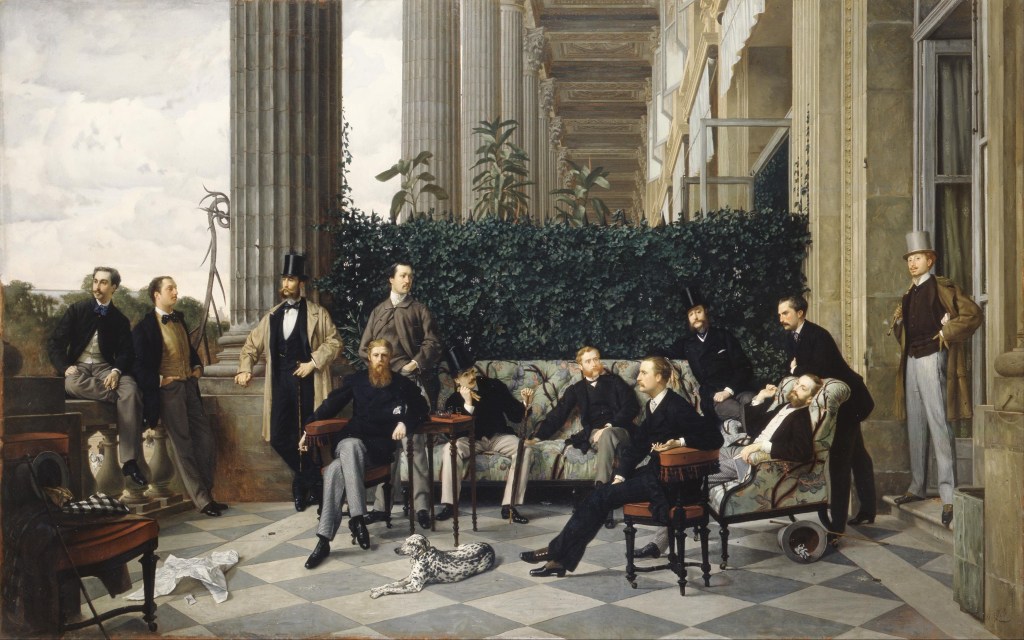
One sees the balcony of a social club prominent in the years of the Second Empire, set up as though deliberately to thwart and block what otherwise would be the irresistible onrush of — not any proverbial locomotive — but the great weight of a colonnade imposing in length, regularity, and scale.* That evidently the gentlemen assembling here pay the architecture around and primarily behind themselves no heed, is amongst the more eye-catching items in this scene of the beau monde.
* The building is the Hôtel de Coislin which faces the Place de la Concorde, and to judge by the recent images which are readily available, the balcony where these twelve gentlemen gathered was situated elsewhere than right at the end of the colonnade. — Initial information regarding them and the painting may be gleaned from the webpage maintained by the museum. Further inquiry would consult the catalogue of the exhibition it, with the Fine Arts Museums of San Francisco, devoted to him some years ago (possibly with different emphases in the two cities).
They have their backs to it. The group’s here and now stands athwart (this is no mere façon de parler) a very great force patent in the arrangement of columns.* Optically this architectural force is already actual: anyone intently looking at the painting cannot but take note of what those gathering on the balcony evidently do not, the rhythm whereby the impetus in the architecture advances towards them. And beyond them! Yes, it will act yet more forcefully insofar as anyone who views the painting extrapolates from what is shown of the colonnade to the rest of it, that implied part which the gentlemen could very well see, if in pauses of conversation they do chance to glance at it, and which the viewer, orientated as he will be in the gallery, would have to turn around to regard — adding it imaginarily, of course.†
* Does one need a painting to show how with stone and other concrete materials architecture can indeed make music? — Those who permit themselves to see/hear it may mean something rather than nothing when they mention the “nunc stans” or even (why not?) a “hic stans,” certain philosophical objections notwithstanding. † Granted, the placement of the column nearest the group and also the viewer may seem not quite so regular, with regard to the whole row behind it, jutting a bit out of line, so to speak; this gives some further food for thought. On the other hand, the divergence may simply follow from a perspectival adjustment that was taken just a little too far. — This matter is perhaps another for the technical specialists.
Rather at variance with the case of the 1889 still-life, here this group of gentlemen has already counterposed itself to the course of time, and so there seems to be no deliberate trickery, no clever embrace of a more complicated temporality, in the painter’s approach to them. The painting does immortalise them as they were at that time in their lives, with a large store of youthful beauty. From which it does not follow, however, that this painter, like many others then and now, held to the notion that a moment of truth does not run away (правда не уйдетъ)5 or that it will not run away from us (wird uns nicht davonlaufen). On the contrary, one may imagine him espousing the notion (nearly brutalised by much reckless usage) that a true image of the past darts by (das wahre Bild der Vergangenheit huscht vorbei)6 — for he too came to know a version of the fugitive’s life, some years after 1866. Yes, experience like his would conduce to set all that is past under the aspect of flight. So regarded, if a true idea does abscond from those overcrowded darkling plains, lighting out for the present, soon, one way or another, how ever could it not vanish whence it came. Its velocity went for nought; recapture will likely occur. Seldom can the idea then be retrieved. — Whenever this conclusion arrives at least a little melancholy is indeed worked on those who ponder it. And, to circle back to the high-society gathering in a painting which indeed seems to deliver a true image of the Second Empire, they all may be considering the matter, in their expressive silences which bespeak the liveliest of inward conversations, otherwise called thought, each is entered into with himself, separately. — How does it transpire, they all were perturbed to think, amidst so many splendid semblances of civilisation, that their century’s rapport with the past becomes fleeting like never before?
To typify this rapport: it itself was preparing to flee, evaporating into the distance. Manifest in its stead, for those who could read the signs, what else remained, if not
l’expansion des choses infinies,7
or else an obvious pathos, fruit of patently theatrical self-displays which, more and more as the years passed by, provoked no questions from keener observers, but simply distaste and recoil. Avoidance, however, had to remain mobile, were it not to devolve into yet another posture. Thus the stances taken by these dandies, as all the twelve were, though variously — to judge by their appearances in the painting — had necessarily to diverge from those they read of in the wittiest and most worldly authors, whose main works, it stands to reason, each knew practically by heart. So, neither the stratagems by which recent predecessors had sought notice, assuming the profile of those who go further in their mockery than even the penny-press does, not omitting to mock themselves (plus moqueurs que les petits journaux, moqueurs à se moquer d’eux-mêmes), or turning into a self-advertisement of its own the fact of not yet having managed to make a name for themselves in the world where they want to shine (n’ayant pas encore pu se faire jour dans le monde où ils voudraient se produire),8 nor the mystification more consequentially enacted by those few contemporaries who did realise the look of a palace is not vouchsafed to everyone, but anyone may still seem to be a labyrinth (n’est pas palais qui veut, mais on peut toujours être labyrinthe)9 — none of that could be theirs. To match the conditions of the late 1860s, some other demeanour and style of dandyism was requisite; this the twelve Parisian gentlemen well knew, and the evidence of the greater reserve they adopted in answer to these challenges is imbued everywhere in the painting’s careful rendering of the details. This reticence, I submit, heightens or even is the thing which no one, I do hope, will seek to belie, namely, a considerable beauty. Impudent would such carping disrespect be, and, fortunately, the less likely to obtain a hearing, since this quality as portrayed does not merely act seductively on the eyes, but is also, imaginatively, that which the ear registers and even perhaps what the nose perceives (these fellows’ eau de Cologne may entrance it). Optical, acoustic, and olfactory impressions felicitously conjoining, the beauty may readily take a place in the memory. Probably due to, consequent on its reception there, the painting comes to seem so truthful, the urbane past from which it flits as its image, so worthwhile to find again.
Venue of this reticence of disclosure, or these disclosures of reticences, was one of the most notable of society clubs in all Paris. It towered as a pinnacle of that set of relations which are specifically social, the searching for allies and antagonists, past, present, and future, without the full edifice of whose ambiguities, materials more than subordinately cemented into the general design,10 the nineteenth century capital never could have become what it was. Such a peak has its perils, but some saving graces as well. For one, from it those relations may be surveyed, and this act could in some sense make a promise of their surpassing. For another, its denizens might exempt themselves from them, by tacit agreement, vacating relations of this kind in the manner of a pause, for a short while at least. So, for what else might this intermission clear the room, albeit briefly, if not a higher urbanity? Probably its debut there and then, realising itself on the balcony between these urbane men, the painter also immortalised in 1866. — But note the external hush amidst which, evidently, this higher form of urbanity comes into focus. Society, so to speak, must fall silent before such a moment can transpire. (Should one choose to hope that its arrival presages any more lasting condition at all, this really would be a point to heed, even while opining, perhaps with tell-tale vigour, that such an anticipation never just amounts to wishful thinking.) The wordless understanding between the several attendees, and the soundless discourses each enters into in himself, as the painting depicts all of it, are paired with a most purposive quiet. How then not to think already of the music that soon would set itself exemplarily avant toute chose —
Sans rien en lui qui pèse ou qui pose11
— apart from society’s stagnant air, its ever-repeated farces of friends versus foes? Possibly these dandies of the Second Empire, pensive as they were, had ears open for the difficulties this music of an other future hinted at, the troubles intimated if lives will be lived otherwise than “socially.” Perhaps they too were “listening hard.”
Much can be read into their mien by viewers who know something about Parisian life towards the decade’s end. The interpreting (when germane and genuine) may convey some insight if not instruction about that circle’s urbanity. An inner lining of the urbane attitude in its better variants, apprehension, did not remain alien to them: faint traces of suspicion on unflappable thoughtful faces, intuited some part of what awaited them all. Founding, though in brief interlude, a club apart from the society’s precipitous haste, under those circumstances, could itself also not but be a “business” regardless whether or not it will cover its costs (gleichviel ob es seine Kosten deckt oder nicht ein »Geschäft«).12 Nothing in the endeavour would come to pass so simply. And yet, each with his refined solicitude, as the artist memorialised the scene in 1866, did entail that the concern for beauty and the beauty in concern still augmented one another.
Out of Paris the sadness of that era’s endings was at times rendered in paint with a delicate, perhaps even a more delicate touch; artistry which viewers would have noted in a lesser-known masterpiece this exhibition had the good sense to include.
Not quite melting away into air, but fluttering slightly in the breeze, are the flags at a coastal resort of the Second Empire, which during its last summer entranced the eyes of one visitor, Claude Monet. Over Trouville, in those months of 1870, the welcome they extended to the beau monde from Paris and abroad, already has a forlorn tinge. Troubles, these harbingers seem to whisper, are imminent.
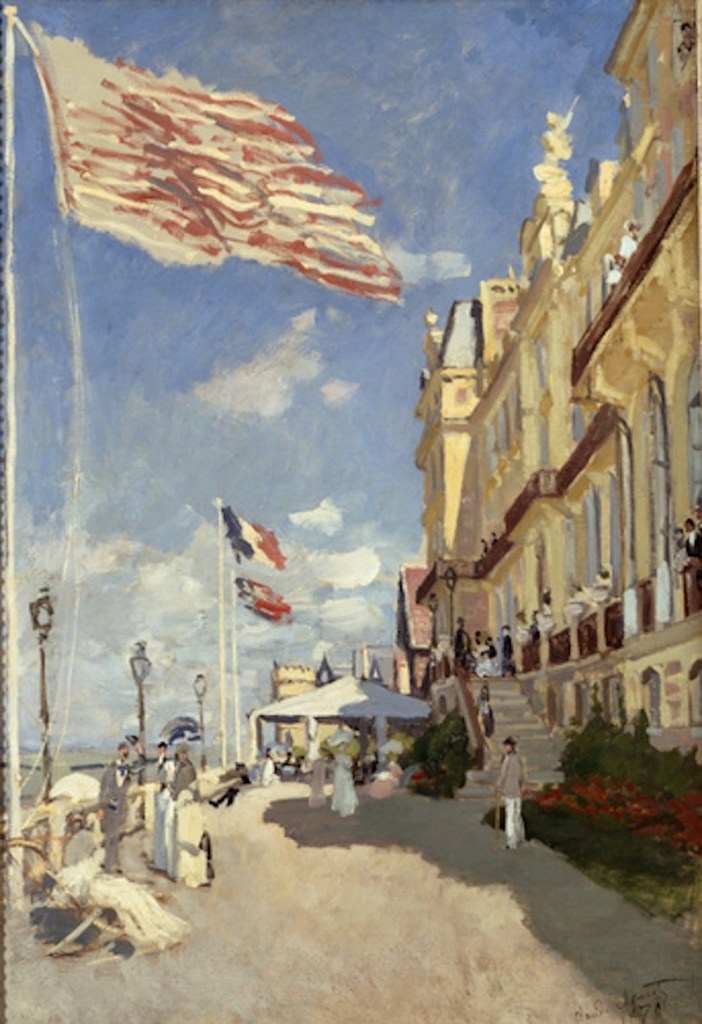
Symbolism clouding this scene perhaps a little too fully, is counterbalanced by the joy taken in the impressions. The caresses of sea air, and its sounds, return via the eye, or sweep over most viewers as something they themselves once knew: such is this painter’s wondrous artistry! The desire of revisiting awakes. For, even at so late a moment, in some places and times in the France of the Second Empire, one could find oneself amidst relations whose character was less narrowly social. In a town like Trouville, some other quality might have set the tone, due not least to the presence of visitors from abroad, perhaps. (A realisation with a certain poignancy, in 2025, in view of events just across the river in Deauville, as well as throughout the capital and across the country.) In search of allies and antagonists one could lose less of one’s time, while residing in a locale where, as in such a place during summer months by the sea, the locals, their countrymen from elsewhere, and various foreigners were all to be encountered. Having left society in the stricter senses of the term behind, everyone staying in those maritime regions was there on vacation to some degree, or they should have been. Whereas during the rest of the year, social relations in their entirety constituted a business on which those denizens of the nineteenth century had to bestow serious attention, on the coast it all loosened up, and thus they, if not in effect disregarded, could be approached more often in a playful manner. Look at the strollers exchanging pleasantries on the promenade, lower down on the left-hand side of the picture: the gentleman acts his part with an extra aplomb, going with a touch of irony beyond the role’s mere requirements, suggesting by the over-emphasis that he is sporting with them, in levity that the ladies do understand and appreciate. This is conduct which, while it might not amount to an error in other seasons, nonetheless enjoys more latitude on holiday. — À propos the painter’s “impressionism,” he liked to render the light when nature was more patent, but also the lightness where society was less so.
Yet the pressures of that year were also registered, though obliquely. Visible in the painting is not nearly the number of people one might have expected; this fact may be significant circumstantially, if one seeks better to understand the public’s mood, the political atmosphere as the Second Empire slid to an end. Moreover, now not an inference ex silentio, but something tangible, a deliberate painterly treatment of the national insignia, is indicative in its own right. These three flags look to be in disrepair, not in tatters, certainly, but hardly well-tended to, either: this a condition which should not be ascribed to the artist himself, as though on this point he were expressing his citizen’s opinion through a pictorial commentary. Rather (which is quite different), the negligent handling of those things he records, faithfully, as an artist. Hence the implicit denigration, if so long afterwards one seeks to assign it to anyone in particular and not take it simply as having been one further “sign of the times,” should be attributed to the municipality, the hotel, etc. — in which case it would embody, not necessarily a subtle voicing of dissent by the lower echelons, but (it is much more likely) states of exasperation and exhaustion, marks, scars, wounds left on the mœurs by the era’s duelling névroses nationales.
The international system, around 1870, seemed, to keener witnesses, ever more to signalise the approach of its own obsolescence; realisations which abetted grave dissatisfaction in turn, in the onlookers and also amongst those who were direct participants in it. What in the world’s next chapter, whenever it began, could offer semblances of order and arrangement? Or should instead one expect everybody would soon openly embrace and avow un immense dérèglement de tous les sens?
Dread sprang further up because states, much like the denizens in society, always were searching for allies and antagonists: a disquieting parallel. Those who did glean insights on one plane (or scale) were better able to illuminate the intricacies hinted at on the other, and vice versa. Conjectures about where it was all heading, then soon quickened with plausible foreboding. — While during the same period, trepidation about the strife to come also was increasing. Some years before, the Civil War in the United States already illustrated, spectacularly, the developments which nascent industrial technologies were bringing about in warfare, prompting bleak trains of thought; whereas closer by, the naval battle between the Union and the Confederacy, just off the French coast, near Cherbourg, in June 1864 had drawn attention, including the interest of the two main Impressionists,* and fostered the notion that battlefields in wars to come would often be sited far elsewhere than the territories of the belligerents. Thus was further reflection on these matters given a provocative starting-point. — Ever nearer the horizons of perceptibility came the aspects that a half-century later massed together into “la guerre totale.”
* Two paintings by them about this event are on view at the Metropolitan.
Soon to break out, the war of 1870-71 contributed significantly to accelerate these developments. (Caution is especially important here, because their velocity became such a factor in its own right, hardly to be ignored: therefore one should take even greater care to avoid anachronistic statements in this field.) En avance the painting of midsummer, one may say without risk of ex post facto appraisal, contains some of the dark mood correlate to the new modes of warfare. Symbolism! — imminent gloom figures there in, as the shadows. (What ever may be the things which have melted, are melting, or shall melt into air, symbols are not amongst them. Would anything human have power to live at all without a solid currency of symbols?)
This seaside picture may be a portent. If so, one will wonder yet again how sights, sounds, and smells do come together to solicit — not a memory, but an anticipation.
Researching a bit further this Monet of 1870, amongst those few images that flit by on the route through the past and out again, might prove to be time well spent.
Perhaps not entirely by an accident of timing, now on view at the Metropolitan is an exhibition about the Paris period, early during the Troisième République, the formative decade of the expatriate American painter John Singer Sargent.*
* Later this year the exhibition will travel to the Musée d’Orsay.
Son of an itinerant family, he studied in that city at the École des Beaux-Arts, and then ascended to the first rank of painters, excelling as one knows in high-society portraiture. Years later he transplanted himself to London. — The biographical dimension, though intrinsically these topics are fascinating, interesting enough certainly that there may be reason at some point to dwell on them a little,13 does not concern me here, and besides, why rehearse items that anyone may look into for himself? — What should elicit some thought, however, are the professional skills which, one surmises, aided him greatly in his rapports with clients, past, present, or prospective, and with that part of the world of art with which he had to deal. In Paris during those years, how far was such a height of skill the exclusive preserve of an outsider such as he? What distance must have been maintained, that he could “listen through” the given social relations, and then do with them what he would, as it were, cementing them into his own designs? Had not this portraitist to withdraw his self behind some captivating or convincing persona or personæ?
All of this commerce with his environs bears thinking on. Real insights would then come (so I imagine). Thus could one plan to revisit or visit the Paris œuvre, without too many useless projects, words, or passions, too much time unrequited or lost.
His changes of pace, his frequent travels, his leaves of absence from Paris, might themselves then be comprehended better. As would the works he created under other inspiration and elsewhere. — Happily, on them too the exhibition bestows the right degree of attention; it features an assortment of these marvellous paintings.
The painter’s interest in Spain’s art was pronounced; he spent much time with the Old Masters at the Prado. Nor did he himself neglect Spanish themes, and then another of his loves, the country’s music, also came into play. So, for example, one of the most intriguing of these paintings shows it in performance — kinetically.
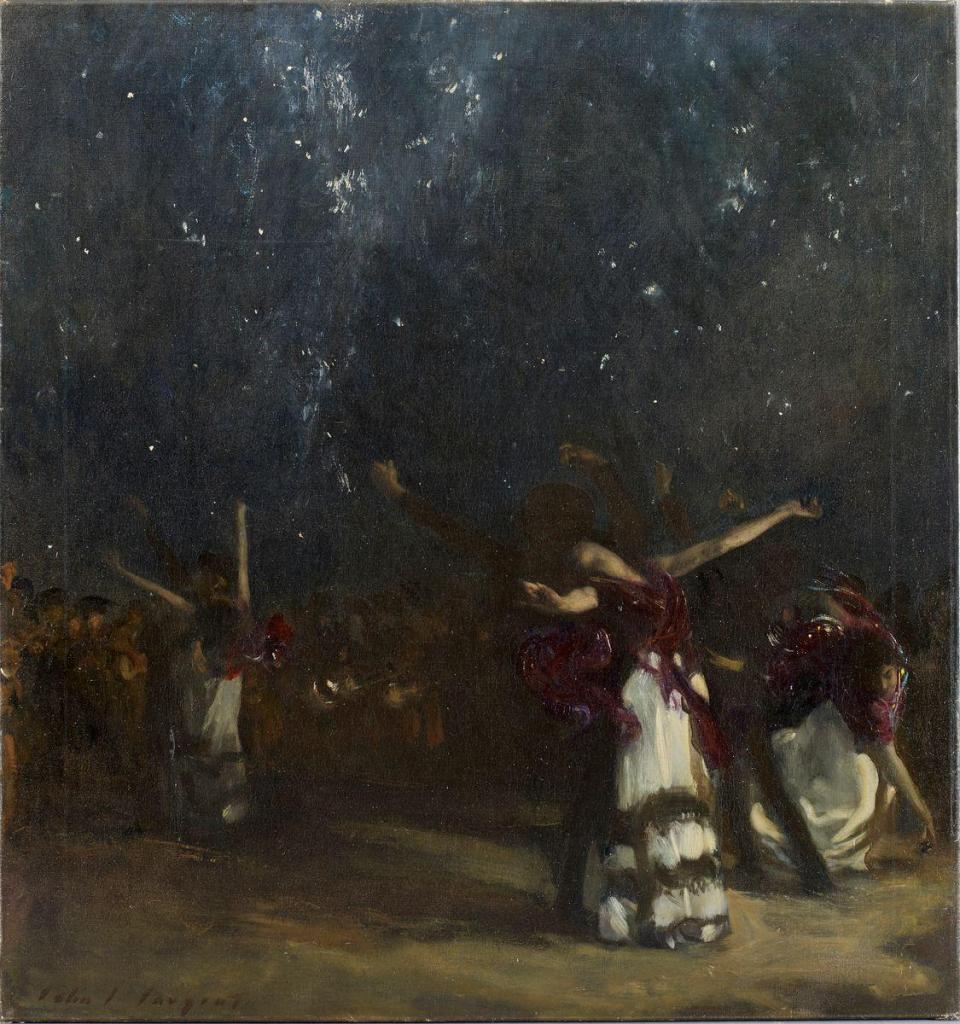
Its nocturnal setting by itself distinguishes this work from those spoken of earlier. An other symbolism, that of night alone: rather a risk for any painter, given how readily bathos or banality can weigh down the results. Not this time! Here it seems everything is listening, the responsive darkness too, everything dancing or poised rhythmically to dance. — Palpably one may move, if only virtually, to join in, and by the action of being afoot outside oneself in the throng, ecstasy as this art conveys it may be more fully “understood.”* Night emboldens steps out that set one beside oneself: one’s understanding of the thing’s potent symbolism is bettered by implicit metaphors like these. Taking visual form they do leap in this painting; their great agility attracts and inspires eyes and ears all at once. Ἔρως is here, its salience is undeniable, though indeed it avoids dissipation, knowing well to fortify itself with dextrous self-restraint; the music and the dance come into their own as a result. At most one scents but slightly things discordant with the better versions of Apollo.
* How one’s reflexes may take one “ahead of oneself,” that is a if not the question. — Ἔκστασις, as a “state,” also invites some consideration. Doesn’t the “στάσις” within it throw a clair-obscur over everything? — “Night,” too, sounds curious. A word as if predestined to join with both “music” and “thoughts,” while ideas take flight by its nearness to “nought” and “not.” — When night is true, what wouldn’t be permitted?
Yet, in frankness, there is some ferocity off in the wings of this Singer Sargent. The music calls back a memory of the wars which tried the country throughout the century. Just because it is so counterposed to them, they could be brought again to mind by it: that would probably suffice to account for the association. Moreover, however, here some tincture of the one opposite may be passing sub rosa into the other, much as can happen whenever des extrêmes se touchent. Perhaps this also should be heeded, for a fuller if not a total clarification of why the unease arises.
13 Notes
- Fernando Checa (editor), Proust y las artes. ↩
- Friedrich Nietzsche, letter to Bernhard and Elisabeth Förster, undated, around the end of 1885. ↩
- Götzen-Dämmerung, “Streifzüge eines Unzeitgemässen,” 1. ↩
- Karl Marx, “Der achtzehnte Brumaire des Louis Bonaparte,” i. ↩
- Fyodor Dostoevsky, Преступленіе и наказаніе, pt. ii, ch. i (Русскій Вѣстникъ, vol. lxii, no. 4). ↩
- Walter Benjamin, “Über den Begriff der Geschichte,” v (in part a quotation from Gottfried Keller (?)). ↩
- Charles Baudelaire, Les Fleurs du mal, “Spleen et Idéal,” iv. ↩
- Honoré de Balzac, La Maison Nucingen (the second paragraph). ↩
- Jules-Amédée Barbey d’Aurevilly, Du Dandysme et de G. Brummell, x. ↩
- Vide Herman Melville, Pierre, bk. xv, i. ↩
- Paul Verlaine, Jadis & naguère, “Art poétique.” ↩
- Martin Heidegger, Sein und Zeit, pt. i, sec. ii, ch. ii, § 59 (with an inversion in syntax). ↩
- Vide Stephanie L. Herdrich (editor), Sargent and Paris. ↩